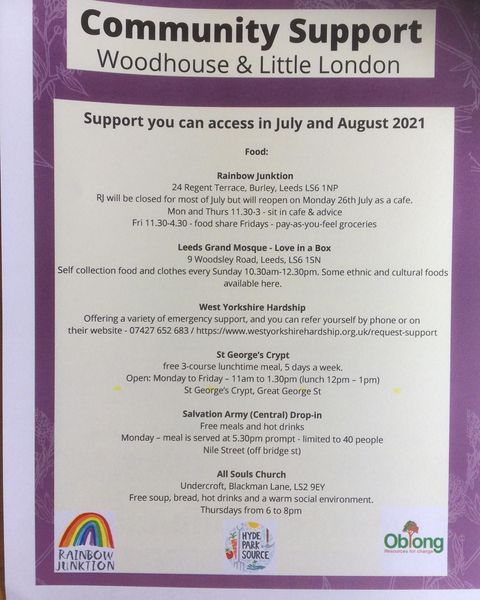
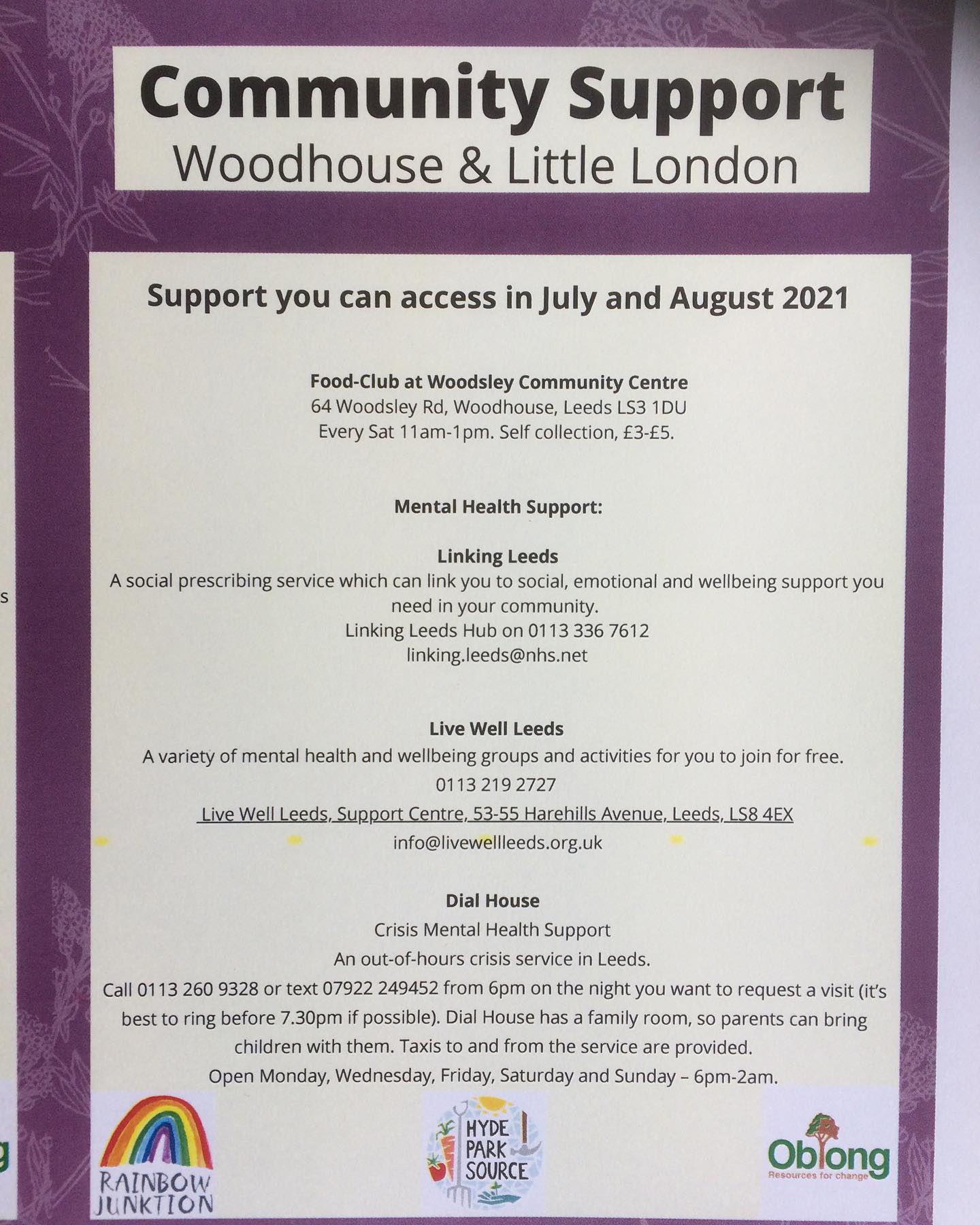
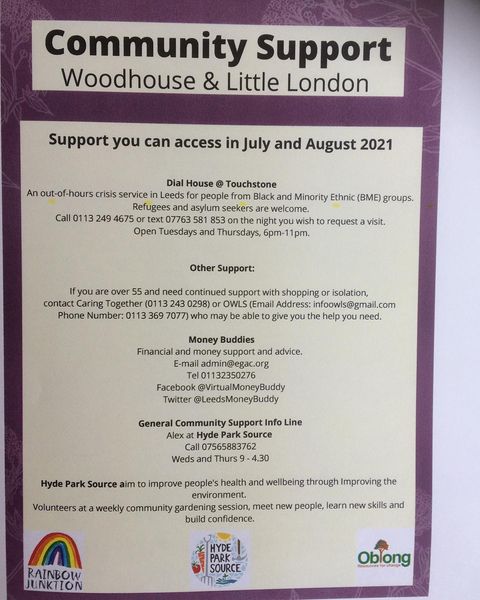
End of the Love Woodhouse & Little London Food Project


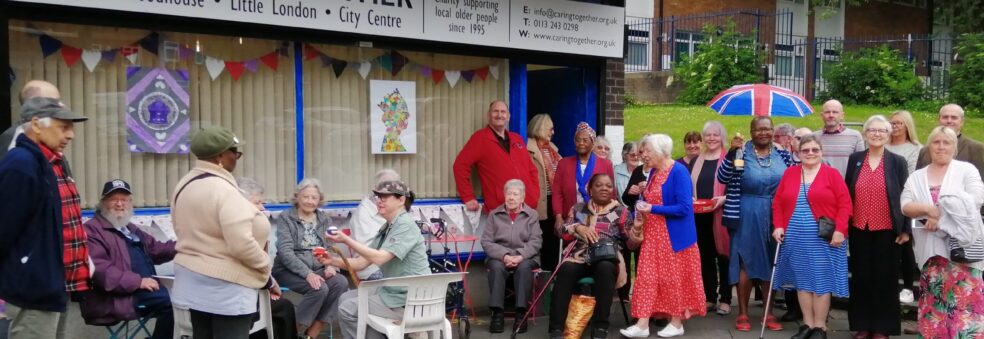
The country’s first ever national Thank You Day is today Sunday 4 July!
We all have someone we have been thankful for particularly over the last year and half.
In our local area we have been incredibly thankful for all in the community who have stepped up to help each other through these difficult times – although we are not at all surprised to find that our community is there for us all when it matters!
Catching a clip from “A Show Of Hands” on Radio 4 Extra took me back to the days when I had lovely hands with long slender fingers – almost worthy of being a model for hand cream or nail polish adverts. As a child Mum would tell me I had ‘a pianist’s hands’ and she being an accomplished player herself, probably knew. Having lessons from early childhood in the 1920s, she was forever in demand at school – St Michael’s in Headingley, now the Parish Centre. Mum would often play for morning Assembly but then would come the call “Dorothy can you play for singing (or dancing class)?”. Goodness knows what happened to the school pianist as Mum always put down her lack of learning to having been called upon to play. The boy sitting next to her in class often complained to the teacher how Dorothy was cheating by copying his work. That boy was Alan Pedley who in 1975-76, became the Lord Mayor of Leeds.
Mum came from a talented musical family, her brothers playing violin, saxophone and banjo and on the keyboard side, her uncle was an extremely gifted pianist and accompanist who sadly passed away at the age of 31. The family tree reveals many church organists and organ builders living around Woodhouse and Hyde Park, so all must have had those wonderful hands. We had a piano in the front room of my childhood home, a wedding present to Mum & Dad in 1937 and I remember well its beautiful Burr Walnut casing. Mum would play at any family gathering, but at other times when the front room was out of use and the coal fire unlit, she would put on her coat and headscarf against the chill and play some of her favourite melodies, in particular ‘Vilia’ from ‘The Merry Widow’ or – in the style of Charlie Kunz – “Tea For Two” and “Walking My Baby Back Home”.
Any attempts to teach myself to play failed miserably so I was not to continue the tradition sadly, something I have since regretted. When moving house in 1970, Mum’s beloved piano was sold – for £3! It included the piano stool too, full of sheet music. Oh how I would have loved to have been able to look through those gems now. My late brother in law was a brilliant pianist, excelling in jazz and classical was a Lecturer on the first Jazz & Light Music Course in 1967 at Leeds Music Centre, now the City of Leeds College of Music. His sons and mine all are musicians, guitar, bass and percussion. Me? After years of choral and show work I can ‘follow’ sheet music but still cannot sight read. I used to love knitting, mainly baby clothes and simple crochet but advancing osteo-arthritis put a stop to that. As was mentioned in the radio clip, although I needed no reminder, advancing years can bring along crooked fingers and nobbly knuckles. Mine are no exception and coincidentally my Sister had the same misshapen hands, as did our Mum. All hail Arthritis! Child-proof tops are impossible to open without the assistance of a special gadget, necklaces which pop over the head are preferable and as for securing earrings, the ‘backs’ almost always end up on the floor. Can I have a ‘show of hands’ from anyone else sharing this plight? I certainly don’t show MY hands more than is necessary and the only keyboard keys ‘played’ being on my laptop.

After more than a year of separation, this National Writing Day is all about connection. On 23 June, as we move towards the reopening of the country, join First Story and connect through creative writing.
This National Writing Day we’re challenging writers to #FilltheBox with a piece of creative writing – a poem, a letter, a story – using the theme of connection. Whether it’s in 280 Twitter characters or on a post-it sized piece of paper, there’s a space to write for everyone. An average post-it note is around three inches tall and wide. If you’re drawing your own box, try imagining the length of three bottle caps!
More details here https://firststory.org.uk/writeday/ with tips on how to get started and details of how to share your piece if you wish to. Or, of course, you could write it just for yourself
People in Leeds can also continue playing their part in keeping virus figures down by following the guidance in each individual setting and remembering:
For full details of current COVID-19 restrictions can be found at: https://www.gov.uk/guidance/covid-19-coronavirus-restrictions-what-you-can-and-cannot-do#may-whats-changed
More information on how and where to get test in Leeds can be found at: https://www.leedsccg.nhs.uk/health/coronavirus/coronavirus-where-to-go-for-testing/
For the latest on Leeds City Council services, please visit: https://www.leeds.gov.uk/coronavirus/our-services
It’s fortunate that we, meaning people living in Yorkshire or similar counties, if there are such things, now have only one infection to worry about. We can reasonably expect not to be felled by smallpox polio, TB, diphtheria or any of teeming diseases that once shadowed our lives.
So, along with the amazing progress of the Covid vaccines, we should all be as cheerful as Pollyanna on a good day. It’s sad that we’re not and it’s largely, I think, because we’ve accepted the notion that physical disease and mental disease cannot be separated, so that even if we don’t die of Covid or find ourselves permanently disabled by it, we can still find something to moan about.
Of course, physical and mental health are very much connected but to force them both into the same playground, under the vague and modish heading of ‘wellbeing’, doesn’t help.
Mental diseases can be alarmingly acute and life-threatening, as much as strokes or heart attacks; they can also be destructive and debilitating on a less violent level but the usual mental effects of the pandemic – the ones that people complain about on just about every radio call-in show all day and all night – are in a different class.
Anxiety over the possibility of losing your job, natural distress over the early loss of a parent, insomnia or depression are not, in most cases, medical or psychiatric problems because they don’t have professional solutions. They are, like indigestion or low-grade mouth ulcers, part of life. They lie within the is the remit of not being dead.
Dr Samuel Johnson (1709-1784) suffered crushing episodes of depression and was beset by so many verbal and physical tics that, if you didn’t know he was the wisest man in the land, you would have gone to great lengths to avoid eye-contact.
He also, I think, had the best the best advice for people who want to improve their mental state without recourse to drugs, mindfulness classes or other unnecessary expenditure: ‘If you are idle, be not solitary; if you are solitary, be not idle.’ In other words keep busy and keep talking.
Johnson would sometimes turn up uninvited at Covent Garden market after a troubled night and take his mind off things by helping early-morning fruit and veg traders to set up their stalls (they didn’t mind; he was a big, energetic man and good at arranging vegetables).
On his journey to the Western Islands of Scotland he employed a translator (the islanders didn’t generally speak English) to answer questions about, for example, where they got their food or, which started an interesting controversy, who made their shoes.
He did not use ‘talking therapies’ in the modern sense; he was not interested in examining his own ego. But he did perhaps find talking, particularly to strangers with experiences other than his own, therapeutic – the best way to stop the demons which would otherwise be tormenting him.
Which, since we’ve all served our time in solitary, is a very good reason to get back to the pub.